
Come Travel a Sentimental Journey
Was there ever such a thing as ‘The Age of Sentiment’? Well, the Allegri Singers’ next concert may go some way towards answering the question.

The repertoire for this concert spans four centuries and crosses just about every boundary music can cross: from a seventeenth-century Purcell gem to a Beatles classic; from Victorian parlour songs to a Broadway showstopper; from ancient Greek tragedy to a modern American meditation on the healing power of song. What unites them is harder to define than to feel — a shared belief, perhaps, that music at its best does something nothing else quite can.
We have tried to write these notes in a spirit of enthusiasm rather than scholarship — less a lecture, more a conversation. If they send you to a recording, or prompt a memory, or simply make you curious to hear how a choir handles The Drunken Sailor alongside Purcell, then they have done their job.
We would love to see you there. Tickets are available here on the website – click this link.
Music: Les Brown & Ben Homer; Lyrics: Bud Green. Recorded 1944, released 1945.
Few songs capture a moment in history quite as perfectly as Sentimental Journey. Written in 1944 by bandleader Les Brown and musician Ben Homer, with lyrics by the veteran songwriter Bud Green, the song arrived at precisely the right moment — as the end of World War II loomed and millions of American servicemen and women began to contemplate the journey home. When Doris Day, then just twenty years old and singing with the Les Brown Band, recorded the song in late 1944, nobody could have predicted the impact it would have. Released in early 1945, it became her first major hit and one of the defining songs of its era, reaching number one on the charts.
What made the song resonate so deeply was its emotional simplicity. The lyrics speak of longing, of homecoming, of reuniting with loved ones left behind — themes that needed no elaboration for an entire generation living through separation and uncertainty. It became an unofficial anthem for returning soldiers, a soundtrack to tearful reunions on railway platforms and dockside quays across America. Doris Day, who would go on to become one of Hollywood’s most beloved stars, later reflected that the song seemed to mean something different to everyone who heard it — and yet the emotion was always the same. It remains one of the most evocative recordings of the twentieth century.
Henry Purcell, published 1679.
Henry Purcell is widely regarded as the greatest composer England has ever produced, and Music for a While is among the most exquisite things he ever wrote. It was composed as part of the incidental music for Oedipus, a stage adaptation of Sophocles’ ancient tragedy, written by John Dryden and Nathaniel Lee and first performed in London around 1679. In the original context, the song is sung to charm the Furies and summon the ghost of Laius — a moment of supernatural stillness amid the surrounding horror.
And yet the song itself is anything but dark. Purcell sets a text of quiet, almost hypnotic beauty, describing music’s power to soothe the troubled soul and — however briefly — suspend all pain and sorrow. Over a gently repeating bass line, the melody unfolds with effortless grace, building to one of the most celebrated moments in Baroque vocal writing. Purcell was only in his twenties when he wrote this, which makes its emotional maturity all the more remarkable. More than three centuries later, it continues to move audiences with its suggestion that music, even for a while, can make the world stand still.
English folk song, c.1787.
Like the very best folk songs, Early One Morning tells its story not through what is said, but through what is carefully left unsaid. Dating from around 1787, this gentle but quietly devastating lament belongs to a tradition of songs in which young women mourn the loss — or impending loss — of a lover. The melody is serene, almost pastoral, which makes the underlying sorrow all the more affecting.
The “maiden” of the song addresses her departing lover in terms of flowers, vows, and morning dew — the language is soft and euphemistic, yet the grief is unmistakable. Whether the lover is leaving for war, for the sea, or simply for another woman is never stated, and that deliberate ambiguity is precisely the point. Folk songs of this period were rarely explicit; their power lay in suggestion, in the space between the notes. Early One Morning has been sung by generations of schoolchildren who perhaps didn’t fully grasp its meaning, and by generations of adults who understood it all too well.
Orlando Gibbons; this setting by Greg Gilpin, b.1964.
Orlando Gibbons composed The Silver Swan in 1612, and it has endured for over four centuries as one of the jewels of the English madrigal tradition. The text draws on the ancient myth that the mute swan remains silent throughout its life, singing only once — at the very moment of its death — before falling silent forever. It is a meditation on mortality, on the value of speaking truly when the moment comes, and on the ultimate futility of empty chatter: “More geese than swans now live, more fools than wise,” the final line observes, with quiet devastation.
Gibbons, who spent much of his career as organist at the Chapel Royal, brought to the madrigal form an expressive depth that sets his work apart from his contemporaries. This particular setting is the work of Greg Gilpin, the celebrated American composer, arranger, and choral director, born in 1964, whose arrangements have become staples of the choral repertoire across the United States. Gilpin’s touch brings new warmth to the piece while honouring the gravity of the original, allowing a twenty-first century choir to inhabit a four-hundred-year-old grief as though it were their own.
Lennon & McCartney, 1968. Arrangement by Dick Averre.
When Paul McCartney sat alone with an acoustic guitar and recorded Blackbird for the Beatles’ sprawling 1968 double album — known universally as The White Album — he created something that felt simultaneously intimate and universal. The song grew from two sources: the sound of a blackbird McCartney had heard in India while the Beatles studied with Maharishi Mahesh Yogi, and his awareness of the American Civil Rights movement, then at a critical and painful juncture. The “broken wings” and “sunken eyes” of the blackbird are understood by many listeners as a metaphor for Black Americans struggling toward freedom and dignity — an interpretation McCartney himself has confirmed.
The guitar part, built on a Bach-influenced fingerpicking pattern, gives the song an almost classical quality, and the production — just voice, guitar, and birdsong — strips everything back to its essential humanity. Dick Averre’s choral arrangement preserves that intimacy while allowing the song’s emotional weight to be shared across many voices, transforming a quiet solo performance into something communal.
Graham Nash, recorded by Crosby, Stills, Nash and Young, 1970.
There is something almost unbearably tender about Our House. Graham Nash wrote it in a single, spontaneous afternoon in 1969, after he and Joni Mitchell — then deeply in love — had returned from an antique shopping trip to their rented home in Laurel Canyon, Los Angeles. Mitchell sat down at the piano; Nash found a notepad and simply wrote down what he saw: two cats in the yard, a fire lit against the cold, flowers, vases, the particular quality of afternoon light. The song was finished before the day was out.
Recorded by Crosby, Stills, Nash and Young for their landmark 1970 album Déjà Vu, it stands apart from that record’s more politically charged material as a moment of pure, uncomplicated happiness. Nash has said he wanted to capture something real and specific — not a fantasy of domestic life, but the actual feeling of a particular afternoon with a particular person. That specificity is precisely why it has lasted: listeners across decades have recognised in it their own fleeting moments of contentment.
Tennyson/Balfe; first recorded by John McCormack.
Alfred, Lord Tennyson published Maud in 1855, describing it as a “Monodrama” — a psychological portrait of a single, unnamed narrator whose inner world shifts between ecstasy and despair. The famous lyric “Come into the garden, Maud” captures the narrator at his most ardently hopeful: waiting, trembling with anticipation, while the object of his devotion remains inside at the party with everyone else. The garden, the roses, the lilies, the cedar tree — every detail is charged with longing.
Michael William Balfe, the Irish composer best known for The Bohemian Girl, set the text to music that perfectly matches Tennyson’s swooning romanticism. The Irish tenor John McCormack, one of the most celebrated singers of the early recording era, made the song his own in a recording that remains definitive. There is something touching about the Victorian gentleman standing in the moonlit garden, hoping — and the song’s enduring popularity suggests that the experience of anxious, hopeful waiting is one that transcends every era.
Lyrics: Henry Fothergill Chorley; Music: Arthur Sullivan, 1868.
Before Arthur Sullivan became inseparable from the comic genius of W.S. Gilbert, he was a serious composer of considerable gifts, and The Long Day Closes is among the finest evidence of that. Published in 1868, with a text by the music critic and lyricist Henry Fothergill Chorley, it is a song of evening, of rest, of the day’s gentle fading into dark. Its harmonies are rich and unhurried; its mood is one of profound, uncomplicated peace.
It became enormously popular with the choral societies that flourished throughout Victorian England, and was reportedly among Queen Victoria’s favourite songs — which says something about the emotional directness that made Sullivan so widely loved before the Savoy Operas made him famous for something quite different. There is a warmth to this piece that asks nothing of the listener except to be still, which may be why it has survived so well.
Edwin Smith Ufford, 1888.
Edwin Smith Ufford was a Baptist preacher, not a professional musician, but he wrote one of the most durable hymns of the nineteenth century. Inspired by witnessing the heroic work of the lifeboat crews at Port Allerton, near Boston, Massachusetts, he composed Throw Out the Lifeline in 1888 as a tribute to those who risked their lives to save others from the sea. The imagery is vivid and immediate — the storm, the drowning sailor, the urgent appeal to cast the rope — and the chorus has an urgency that made it ideal for congregational singing.
But Ufford and his contemporaries understood that the song worked on two levels simultaneously. The literal rescue at sea was a perfect metaphor for Christian salvation — the sinner drowning in a sea of temptation, the faithful extending the lifeline of grace. This double meaning gave the hymn an unusually wide appeal, and it spread rapidly through churches and revival meetings on both sides of the Atlantic.
Henry Clay Work, 1864; E.A. Parkhurst, 1866.
The temperance movement of the nineteenth century produced its own remarkable body of music, and these two songs are among its most affecting examples. Henry Clay Work’s Come Home, Father (1864) — later adopted as the anthem of the Women’s Christian Temperance Union — tells its story through the voice of a child standing outside a tavern, begging a father to return home to his dying daughter. The sentimentality is unashamedly Victorian, but the social reality it describes was anything but fictional.
E.A. Parkhurst’s Father’s a Drunkard and Mother is Dead (1866) takes the consequences one step further, presenting the child already orphaned, already abandoned. Parkhurst was a prolific composer of parlour songs — the popular entertainment of the era — and understood precisely how to manipulate an audience’s emotions. Taken together, these two songs remind us that behind their melodrama lay genuine suffering, and that the temperance movement, whatever its eventual excesses, was responding to a real and widespread domestic crisis.
Frank Ticheli, b.1958.
Frank Ticheli, Professor Emeritus of Composition at the University of Southern California, has built a distinguished career writing for orchestras, choirs, and — most notably — concert bands. Earth Song, first recorded in 2009, is one of his most beloved choral works, and its appeal is not difficult to understand. In a world that can seem relentlessly fractured and loud, it offers something rare: a sustained, quietly passionate argument for the healing power of music itself.
The text is Ticheli’s own, and it speaks of singing as an act of resistance, of hope, of connection across all divides. The music moves from stillness to something more urgent and back again, tracing the emotional arc of longing and resolve. For a choir, it is both a gift and a challenge — demanding genuine expressiveness, and rewarding it generously.
Folliot S. Pierpoint, 1864; this arrangement by John Rutter, b.1945.
Folliot Pierpoint wrote his hymn text in 1864, reportedly inspired by the particular loveliness of the English countryside around Bath in springtime. The impulse was simple and sincere: gratitude for the beauty of the created world. John Rutter — whose name is synonymous with accessible, emotionally direct choral music — made his celebrated arrangement for the Cambridge Singers in 1984, and it has been a fixture of choral programmes ever since. Rutter’s gift for writing music that feels both familiar and freshly discovered is perfectly suited to a text of such unaffected joy.
Words: Michael Dennis Browne; Music: Stephen Paulus, 1929–2014. Tune from Southern Harmony, 1835.
Stephen Paulus took a melody from William Walker’s Southern Harmony songbook of 1835 and, with poet Michael Dennis Browne, transformed it into something new and deeply moving. Published in 2001, The Road Home speaks of return — to the self, to stillness, to wherever it is we truly belong. It has become one of the most performed American choral works of recent decades, loved by singers and audiences alike for the way it seems to hold, within a very simple musical frame, something almost impossibly large.
Fats Waller, Harry Brooks & Andy Razaf, 1929.
Ain’t Misbehavin’ was born in Harlem in the summer of 1929, written at speed by the irrepressible Thomas “Fats” Waller, composer Harry Brooks, and lyricist Andy Razaf for the musical revue Connie’s Hot Chocolates — a show that opened at the Hudson Theatre on Broadway after a run in Harlem and launched several careers simultaneously. Louis Armstrong was also in the show, and his trumpet playing on the original recording helped make the song a sensation. Waller’s own piano playing — infectious, swaggering, and somehow both nonchalant and virtuosic — became the song’s defining character.
The lyrics, delivered with a wink, describe fidelity to an absent lover as an act of cheerful self-restraint: “I’m saving my love for you.” The comic possibilities are obvious, and Waller exploited them with relish throughout his career. However, beneath the playfulness there is real musical sophistication, and the song has proven endlessly adaptable — to jazz, to pop, to the concert hall, and to the choral stage.
Andrew Lloyd Webber / Hart & Stilgoe, 1986.
When The Phantom of the Opera opened in London’s West End in 1986, it was clear almost immediately that it would become something extraordinary. Andrew Lloyd Webber’s score is full of memorable moments, but Music of the Night is its emotional centrepiece — the Phantom’s seductive, obsessive aria to Christine, in which he attempts to draw her into his underground world of shadow and sensation. Charles Hart and Richard Stilgoe’s lyrics, with their imagery of darkness, surrender, and the intoxicating power of sound, gave Lloyd Webber’s melody exactly the grandeur it required.
The original Phantom, Michael Crawford, made the song his signature, and it has since been performed by virtually every major tenor and baritone in popular music. In a choral setting, stripped of theatrical spectacle, the music reveals its structural strength and its deep romantic yearning.
Harry Warren & Al Dubin, 1935.
Harry Warren and Al Dubin wrote Lullaby of Broadway for the 1935 film Gold Diggers of 1935, where it was performed in one of Busby Berkeley’s most elaborately choreographed sequences — a production number that is still astonishing to watch today. The song won the Academy Award for Best Original Song, and with good reason: it captures perfectly the glamour, the energy, and the underlying melancholy of the Broadway world — the showgirls and chorus boys who live by night and sleep by day, for whom the city never quite goes dark.
Traditional sea shanty, c.1830. Arrangement by Donald Cashmore, 1926–2013.
Of all the sea shanties in the English-speaking tradition, The Drunken Sailor may be the most universally recognised. The earliest documented references place it on ships sailing from Connecticut around 1830, though the song almost certainly existed in some form well before that. As a working shanty, it served a practical purpose — its strong, regular rhythm helped crews coordinate heavy labour, whether hauling lines or weighing anchor. The proliferation of suggested remedies for the sailor’s condition (most of them cheerfully unprintable) gave crews the chance to improvise endlessly, and the song expanded accordingly.
Donald Cashmore — composer, conductor, chorus master, and founder of both the Kingsway Choral Society and the City of London Choir — created an arrangement that brings the full exuberance of the original into the concert hall. Cashmore’s long career was devoted to exactly this kind of work: making music that connected audiences to something alive and communal. It is, when all is said and done, a song about the irresistible pull of a good tune and a shared rhythm — which is, perhaps, what all choral music is about.
Was there ever such a thing as ‘The Age of Sentiment’? Well, the Allegri Singers’ next concert may go some way towards answering the question.

When Rob Berry walks into the studio at Orange Community Radio, he brings with him the kind of easy enthusiasm that makes you feel like you’ve known him for years. Rob is a member of the Allegri Singers, the Bathurst-based choir that has been delighting audiences across the Central West for over four decades.
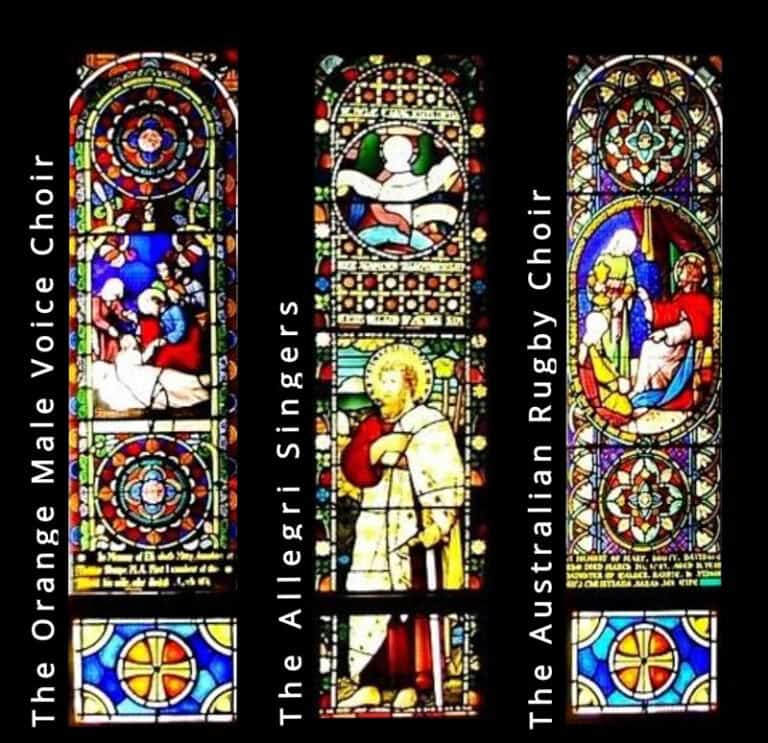
Bringing together three of Australia’s distinctive choral voices for A Choral Kaleidoscope — a collaborative concert that showcases the breadth and variety of choral music performed across New South Wales. The event will feature the Allegri Singers together with the Orange Male Voice Choir and the Australian Rugby Choir, each group bringing its own history, repertoire, and character to the programme.
The Allegri Singers are gearing up for an exciting and ambitious year in 2026, with a program that celebrates both community and artistry. Here’s what’s on the horizon.
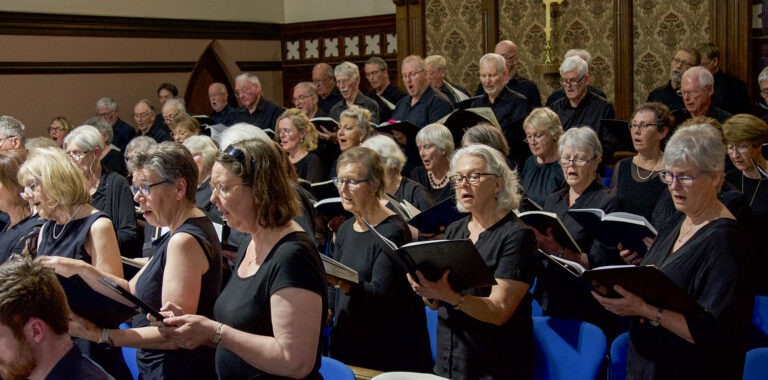
2025 is drawing to a close, and it’s been another wonderful year for the Allegri Singers in Oberon, Blackheath, Orange and Bathurst.